Puxar, but don’t push
Restaurant doors in Portugal have either ‘puxar’ or ‘empurrar’ on them. (Or was it ‘puxe’ and ‘empurre’? Anyhow, the verbs are right).
Because ‘puxar’ sounds like English ‘poo-shar’ this often leaves me puzzled: I find it difficult to resist the inclination to push automatically. Rationally I know there was something the other way round about this, but I cannot immediately connect that to muscle action. So I just stand there for a while wondering what to do, and what not to do.
Linguistically too, there are several things rather peculiar about these two words. Having noticed that today, I expect to be even more puzzled next time I’m there.
-
Empurrar is not a real Portuguese word! It is a loan word from Spanish empujar. Apparently the Portuguese imitated the Spanish j, which sounds as ch in Scottish loch and German Bach, with their French-like uvular rr, which is as close as they can get.
The ‘real’ Portuguese word for this is ‘empuxar’, which actually exists too. This of course comes very close to the opposite: puxar.
Source: Porto Editora
Note All these word have similar etymologies: empujar and empuxar come from Late Latin impulsare, and puxar is from Latin pulsare.
Source: Porto Editora-
Portuguese puxar, although contrary in meaning, shares its origin with English push: via Anglo-French and Old-French (pousser/poulser), it too can be traced back to Latin pulsare.
Source: Oxford Concise English Dictionary
There’s a joke that nicely illustrates the confusion. It’s also
here
and
here
and several other places on the web. It goes like this:
Lisboa. Voo 147 da Manuel Airlines de partida para Londres.
O Comandante Joaquim fala aos passageiros lusófonos do voo:
"Obrigado por viajarem pela Manuel Airlines. Farei agora uns
esclarecimentos para que não tenham problemas em entender as
mensagens do equipamento, que são todas em inglês.
Quando a palavra "PUSH" acender, não puxem, empurrem;
quando a palavra "PULL" acender, não pulem, puxem;
e ao acender a palavra "EXIT", não hesitem, pulem!
When comparing Spanish empujar and Portuguese expuxar, note that modern Spanish j used to be written x too, and sounded like English sh. That is how Sherry derives from Xerez, now written Jerez (de la Frontera), and why French Don Quichote is Don Quixote in the Spanish of his time, or Don Quijote in modern Spanish. Compare also Mexico, which is written Méjico in Spain, but México in Mexico. (That name itself comes from a local language, not from Old-Spanish.)
Galicians are very drastic in this x usage. They use x (in one of two possible orthographic standards) everywhere where corresponding Spanish (Castilian) and Portuguese words have j, or g before e or i. They pronounce it [S].
So the month of July is Xullo in Galician, and even the name Jesus is not protected from this high degree of exiness, as these pictures of Rua Bo Xesús, taken in Lugo show:
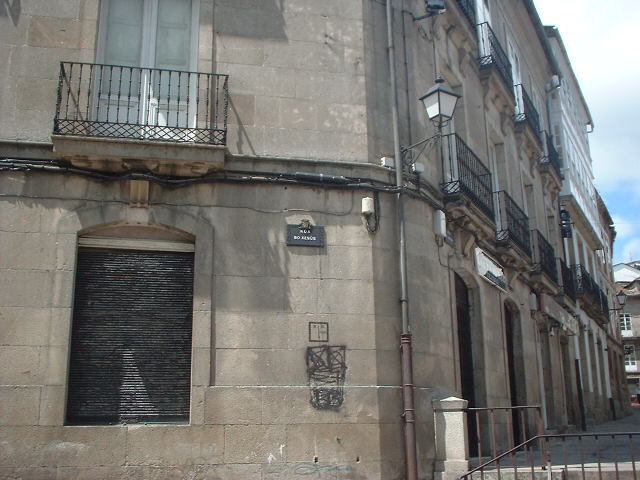
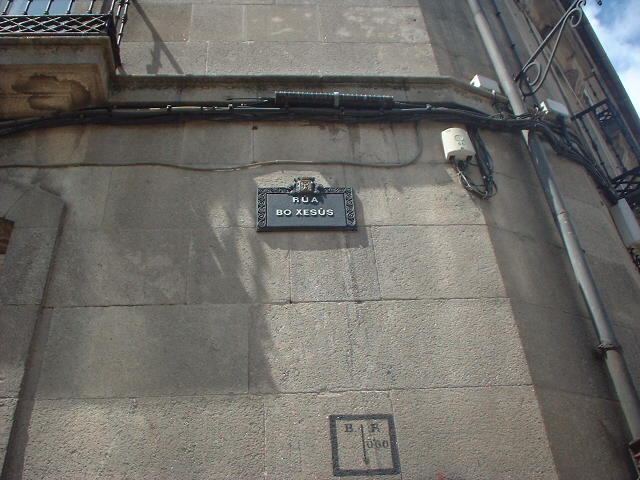
Note that ‘street’ is ‘rua’ here in Galiza, as in Portuguese, and cognate with French ‘rue’, ¡y no se llama ‘calle’ como en Español!